


Introduction
Since I came back to Southeast Asia in 2019, I’ve met many more female founders through my work for Monk’s Hill Ventures.
Which brings me to one number that is very hard to explain.
Women are half the world's population. In the US, roughly 1 in 8 individual startup founders is a woman. Of the startups that do get VC deals, all-female teams account for around 6%. And of the total capital deployed? All-female founding teams received just 2.1% in 2024 — a lower number than 2014. A decade of awareness, dedicated funds, and diversity pledges, and the line has barely moved since 2008. In Europe, the same. In Southeast Asia, data also showed that all-women-founded startups received just 2.1% of total capital raised in the region, making up only 5.2% of deal volume.¹²³⁴
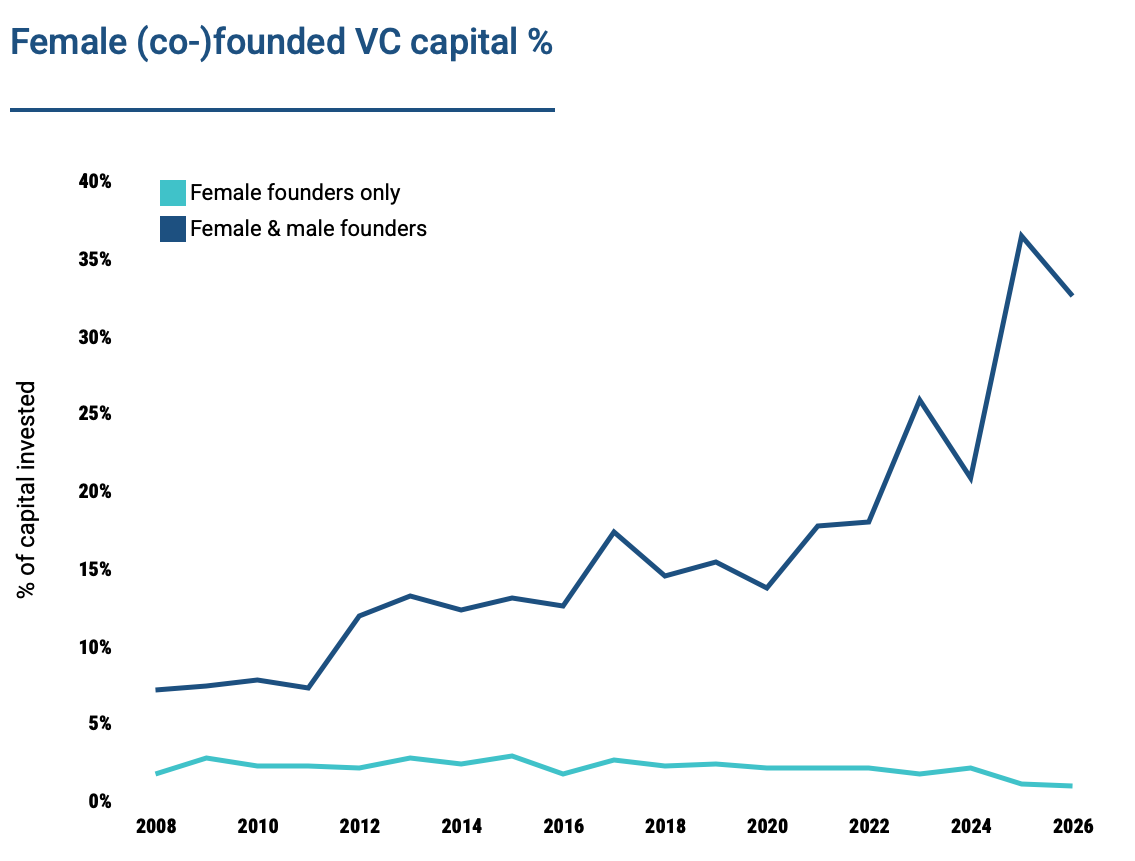
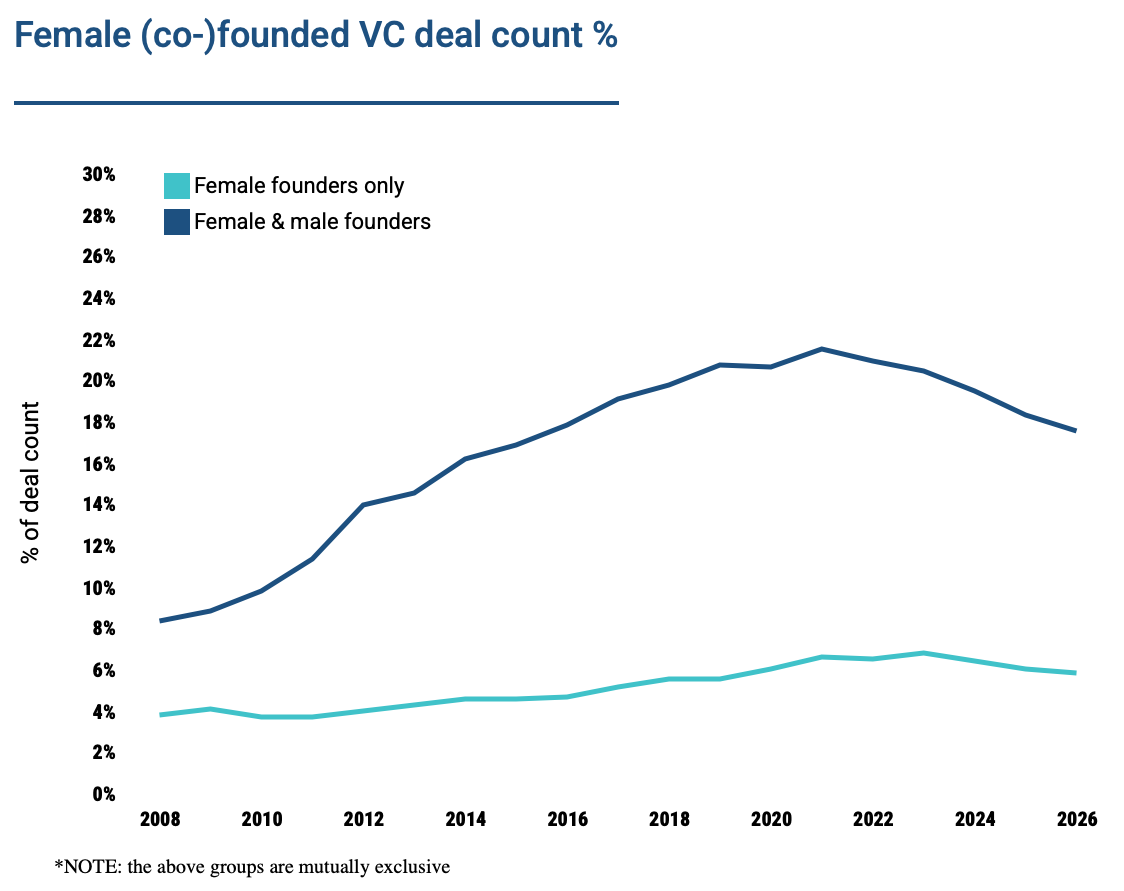
Include companies with at least one female co-founder and the share of VC funding rises to ~20%. So there’s progress there, but it remains that all-female founding teams still receive just 2% of total VC funding - roughly 2 cents of every dollar deployed.
Outperforming, Underallocated
The most striking thing isn't the 2% figure itself. It's that it persists despite the performance data.
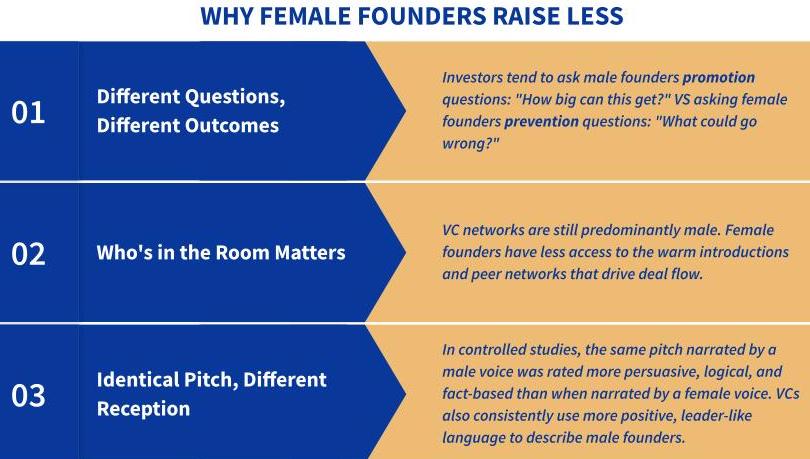
Female-founded companies generate 78 cents of revenue for every dollar raised, compared to just 31 cents for male-founded startups.⁵ They burn less capital. And in 2024, female founders secured a record 24.3% of US VC exits - nearly double their share a decade ago.⁵ The underallocation isn't because of underperformance by female founding teams. Rather, there are a host of other factors (see table below) that contribute to this.
The Southeast Asia Variable
Let me share a factor that drew me back to this region — and why it matters for this conversation.
When I moved from Singapore to the Bay Area in the 2010s, figuring out how to build a career with two young children in San Francisco was barely manageable. Childcare costs were staggering. I had no family nearby to absorb the gaps. Every logistical crack was mine to fill.
Being back in Singapore changed that equation. Proximity to family and access to domestic help at a very different cost structure made a full-time role so much more feasible. That kind of structural support (which is more common across parts of Asia than in the US) doesn't solve the funding gap. But it expands who gets to participate.
Southeast Asia also has a stronger entrepreneurial base than the headline VC numbers suggest. The Mastercard Index of Women Entrepreneurs (2023) ranks Thailand, the Philippines and Vietnam among the stronger global performers in female entrepreneurial activity.⁷ Venture capital funds just a narrow slice of entrepreneurship - and the performance data suggests women often do more with less when they do raise.8
This region is not magically different when it comes to VC funding for women. But it may be more structurally promising than the current data can fully capture.
Is Capital Actually Changing?
And if the Southeast Asian entrepreneurial base is more promising than headline numbers suggest, so too is the emerging capital landscape.
Representation at the investor level matters more than people realise. VC firms with at least one female partner are 2.3x more likely to invest in female-founded startups.9 Globally, women now hold 17% of decision-making roles at VC firms — nearly triple their 6% share in 2014.⁵ In Southeast Asia, that progress is visible.
Jenny Lee, Senior Managing Partner at Granite Asia, is the first woman to break into the top 10 of the Forbes Global Midas List, now leading a firm with $5 billion in AUM. At Vertex Ventures SEA & India, three out of eight partners are women, with nearly 40% of the overall team female10. And in their fourth fund, over 35% of portfolio companies had at least one female founder, a figure significant enough that they carved out a dedicated $50 million co-investment envelope for women-led startups in their fifth fund.11 At Monk's Hill Ventures, our own Susli Lie - a former YC-backed founder from Indonesia - is a Partner. The GPCA's Southeast Asia Women Investors Directory now lists over 420 women across the region's private capital industry, with 154 in senior roles.12
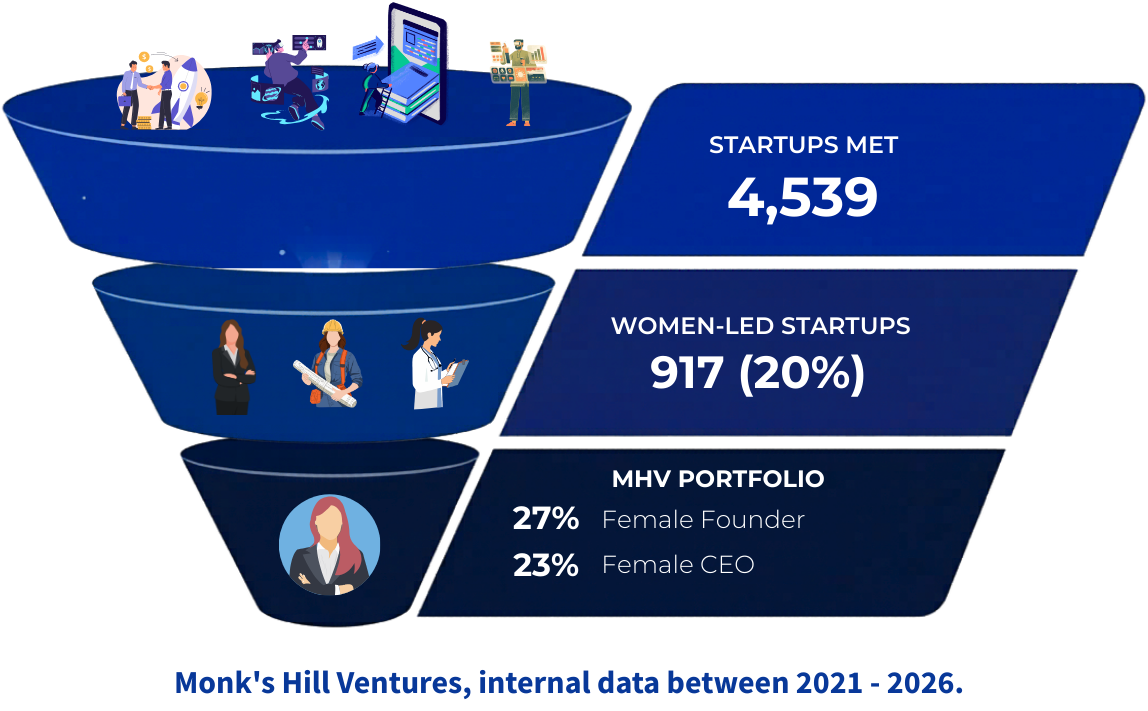
The question of what this shift produces in practice is one that I hope more firms will share publicly. Between 2021 and 2026, Monk's Hill Ventures met 4,539 startups. Just over 20% were women-led. That's the pipeline as it actually exists in SEA: thin relative to the opportunity, but real. And we've backed female founders at a higher rate than our inbound reflects: 27% of our portfolio companies have at least one female founder, and 23% are led by female CEOs.13
Female Founders: In Their Own Words
As I reflected upon the trends above, I asked three female founders we back to reflect on their experience. Their answers were nuanced and pragmatic.
"I get asked: Are you married? Do you have kids? When your kids reach a certain age, would that become your priority?"

Chaly Koh, CEO and founder of Urbanmetry in Malaysia— a city intelligence platform in the male-dominated world of construction and property tech — offered what at first seemed a counterintuitive insight: that the most discouraging advice came from women. "A lot of women mentors told me to give up. They had climbed the corporate ladder and knew how hard it was — the curse of knowledge. The ones who said 'just try lah' were all men." The lesson she draws isn't that women don't support each other — it's that experience of pain doesn't always translate into encouragement to push through it, and that women being more nurturing, may want to spare others the pain.
Her advice to investors is equally direct: "VCs are supposed to find the outlier — the one that goes 1 to 100. But when they assess, they revert to the median. Does this person look like a normal successful founder? That picture is still Zuckerberg in a hoodie. It's very outdated."
"Being an entrepreneur is the best job for a mom with two toddlers — I am in greater control over my time. I highly recommend it."

Roolin Njotosetiadi, CEO & co-founder of Logisly, Indonesia's leading digital trucking platform, is careful not to frame every challenge through the lens of gender — "if I can't fundraise, it must be because I can be better" — and notes that building in Indonesia is hard for everyone. But she names the quieter frictions too: being assumed to be the secretary rather than the CEO, the absence of female founder peers, the practical constraints of pregnancy. And she lands on something that cuts against the conventional narrative entirely: entrepreneurship, she says, gave her more control over her time as a mother of two toddlers than any corporate role ever had.
"I can't control how another party acts. But I can certainly control how I respond, and how I wish to take any interaction forward."
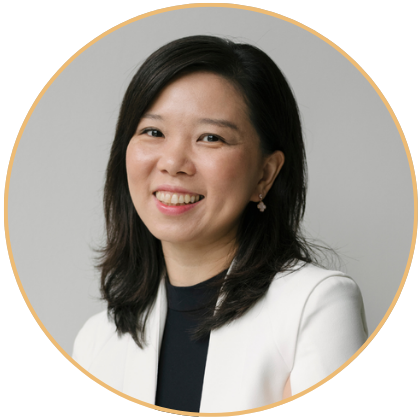
Sue-Anne Toh, CEO & co-founder of Novi Health, a Singapore-based tech-enabled chronic disease and preventive healthcare platform, brought measured clarity to the question of bias. She acknowledges the subconscious factors, the communication differences, the moments that catch you off guard, which included insensitive comments about her pregnancy. And, she always chooses to focus on what she can control. Not resignation, but maturity and self-possession.
Why It Matters Who Builds the Future
The world right now is uncertain in ways that feel genuinely new. Markets are shifting. Old playbooks are breaking down. The ability to navigate ambiguity, hold a team together through chaos, and build trust under pressure - these aren't nice-to-have soft skills. They are the skills. And if you look at who is quietly doing all of that, often with less capital and less margin for error, you will find a lot of women.
There's growing evidence that diverse leadership teams make better decisions, especially in complex and fast-changing environments. Varied perspectives - at the table, in the room, writing the checks - produce better thinking and better outcomes. The data tells me we're leaving a lot on the table. My sincere hope is that we move beyond the 2% number as more investors ask: who isn't in the room? Who are we not looking at?
This article reflects my personal views from working in venture capital, drawing on publicly available data and internal observations. It does not represent the official position of Monk's Hill Ventures.
Footnotes
- Carta, The Gender Gap in VC Funding, 2024. carta.com
- PitchBook Platform, VC Female Founders Dashboard (US and Europe), updated January 2026. pitchbook.com/news/articles/the-vc-female-founders-dashboard
- Female Founders Fund, 10th Annual Review: A Decade of Female Founders, 2025, citing PitchBook data.
- DealStreetAsia, Women Founders in SE Asia: 2024 Funding Review, March 2025.
- BCG/MassChallenge, Why Women-Owned Startups Are a Better Bet (2018). Corroborated by First Round Capital's ten-year portfolio analysis and the Kauffman Fellows Report. Cited in Female Founders Fund Annual Review (2024).
- Kanze et al., Harvard Business School, We Ask Men to Win and Women Not to Lose, 2018.
- Mastercard Index of Women Entrepreneurs, 2023.
- Kauffman Foundation, State of Entrepreneurship, 2022–2023.
- ESCAP / Founders Forum Group, Female Entrepreneurship in Southeast Asia, 2025.
- Vertex Ventures SEA & India, Inspiring Diversity for Success, 2024. vertexventures.sg
- Vertex Ventures SEA & India, Fund V Final Close Announcement, 2023. vertexholdings.com
- Global Private Capital Association, Southeast Asia Women Investors Directory, 2nd edition, 2024. globalprivatecapital.org
- Monk's Hill Ventures, internal data, 2026.


